
LIGA Book vol. 2 “Exposed Architecture”
From Overseas
Daniel Fernández Pascual
The pirate may no longer be defined by the region in which he moves. Instead, the region of piracy may be derived from the presence of the pirate. Wherever an ‘enemy of all’ can be found-upon the seas, in the air, or on the land —there a zone beyond the line will emerge.
Daniel Heller-Roazen
The Enemy of All: Piracy and the Law of Nations
He opened the paneled door to the drawing room and there it was. The afternoon sun streaming through the Victorian window, doing its best to dry off the stale odor of damp carpet, was illuminating it. It may have been four in the afternoon. Perhaps the light was reflected off a silver tray. This moment changed the life and the career of the gardener who revolutionized the way that species travel around the world, and the way different plants grow in confined, temperature controlled spaces. What Joseph Paxton discovered in the afternoon light was a plant. Not just any plant in any old place. It was his Musa. The Musa which he was later to appropriate to generate a botanical revolution the length and breadth of the Earth. One that would strengthen the idea of overseas trade. On the wallpaper of this room decorated in Chinese style in the declining mansion of Chatsworth, the residence of his master William Cavendish, sixth Duke Cavendish, the future Musa Cavendishii was already there, painted in red hues, and —who knows-perhaps too in the lethal arsenic-based green pigment produced by William Morris, founder of the Arts and Crafts movement.
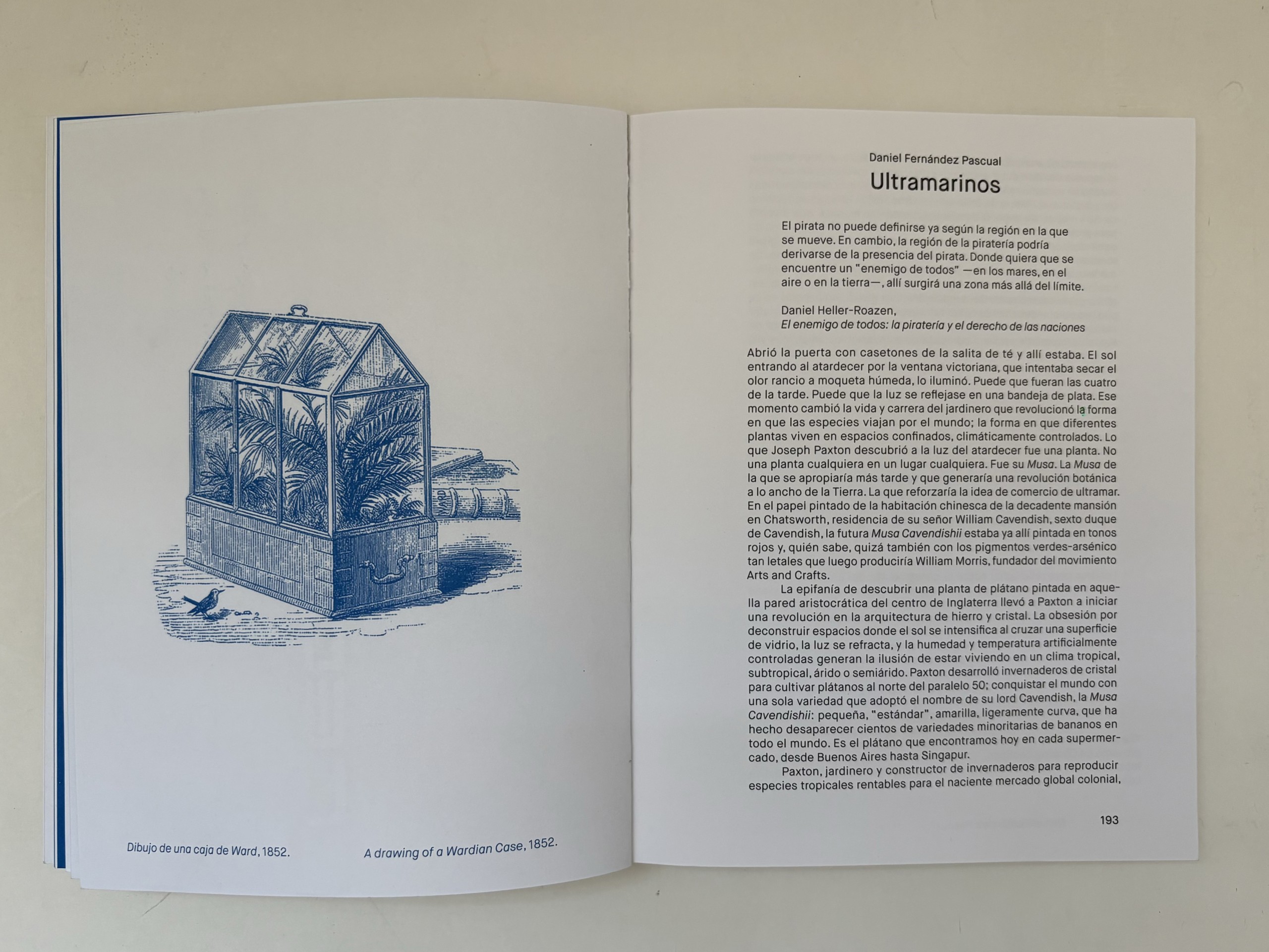
The epiphany of discovering a painted banana plant on that aristocratic wall in the heart of England led Paxton to embark on a revolution in glass and iron architecture. His obsession was with constructions where the sun is intensified by its passage through the glass surface, the light is refracted, and the humidity and temperature artificially controlled, generating the illusion of a tropical, sub-tropical, arid or semi-arid climate.
Paxton developed glass greenhouses to grow bananas north of the 50th parallel. He conquered the world with a single variety that acquired Lord Cavendish’s name, as Musa cavendishii: small, “standard,” yellow, gently curved-and the cause of the disappearance of hundreds of minor varieties of banana from the world. This is the banana found today in supermarkets from Buenos Aires to Singapore.
Paxton, the gardener and builder of greenhouses to propagate profitable tropical species for the emerging worldwide colonial mar-ket, was elevated to the rank of architect of the British Empire. He was commissioned to imagine the space where structures of power could be exhibited. In the mid-nineteenth century he built one of the most paradigm-defining exhibition spaces in history: the Crystal Palace in London (1851), which measured 564 meters long. The modular architecture he invented to create this infinitely luminous space transformed the notion of standardization. The cross-section of the building was repeated along the entire half-kilometer length, as if it were literally an extruded draw-ing. A module that through monotonous repetition occupies a potentially endless footprint.
The exhibition that was held in this building implicitly referred to the colonization of space on a global scale: an empire at its height was deciding how to reinvent landscapes in order to dominate them.
Exhibiting the mechanisms to achieve this task, Paxton’s Crystal Palace became an accomplice to colonial invasion. Beyond the engineering magic of its spatial genius, the system for efficiently enclosing space contributed to the legitimization of abuse and violence against millions of people around the world. One of the most singular architectural spaces in history involved the exhibition of a dual architecture: that of iron and glass, and that of the Empire.
This obsession with creating spatial imaginaries seems to be closely bound up with the nation’s liberal economy. Seven decades after the Crystal Palace, the UK founded the Empire Marketing Board, a spatial propaganda body aimed at placing responsibility for the imperial economy not with its leaders, but on the shoulders of its citizens, with the obligation to buy and consume products of the overseas colonies and territories in order to contribute to the good work of the Empire.
In posters, films, recipes and other visual mechanisms, the so-called Empire Shops were conceived. For a number of reasons, they never actually opened.
This gave rise, in 2016, to The Empire Remains Shop,’ at an exhibition held in London to critically reflect on the construction of space.
What remains today of the concept of overseas, of what comes from afar, from different shores, things that are theoretically impossible to produce here? What would it mean to speculate on the sale of the remains of the British Empire today? This platform aims to explore this coming and going of objects and spatial relations. Rather than designing a new space, it occupies a semi-vacant office building where Barclays bank once had its offices. Its lobby lined with cheap marble from the 1990s also reflects light, like that which triggered Paxton’s epiphany (though I don’t know if it would occur today, were he here). The aesthetics of real estate and the fluorescent signs of agencies announcing properties for sale has become a visual reference point in streets around contemporary London. This is the exhibition of architecture that dominates the city. In the night, acrylic boxes manufactured in special economic zones in southern China light up the adverts for the (prohibitively expensive) house of your dreams. Because in the end, the average buyer of property in the city is not a human, but an offshore company resident in pirate islands and cities.
The notion of exhibiting architecture arises from the ambition to deconstruct the way in which space is constructed. It is like going back in time, spurred by the corrugated rebar enclosed in concrete columns, which take you back to the boat that conveyed it from Lagos, having been forged into steel, produced in turn from a mineral that escaped the clutches of pirates in international waters off the coast of Kenya, having embarked from a delta in Hong Kong, connected by a railroad to a mine deep inside China, where the men who extract the mineral barely glimpse the walls of the tunnel that have been subject to intense geological processes over millennia. In this regard, it is essential to emphasize the social value of independent agents who enable society and visitors to reflect on the reasons behind the forms around them: how this piece of steel came to occupy the wall of your room, how to inhabit this space; and thereby to question your power of choice as a consumer, and the questions of labor relations and human rights that are implicit in the fact of that invisible steel bar in the wall of your home.
Exhibiting architecture is this: the exhibition of relationships. The exhibition of connections and disconnections that make life a bit more intriguing and sometimes allow us to glimpse things through materials we believed to be opaque.
