
LIGA Book vol. 2 “Exposed Architecture”
Architecture and its Double
Anna Puigjaner and Guillermo López (MAIO)
I. A Story from 1974
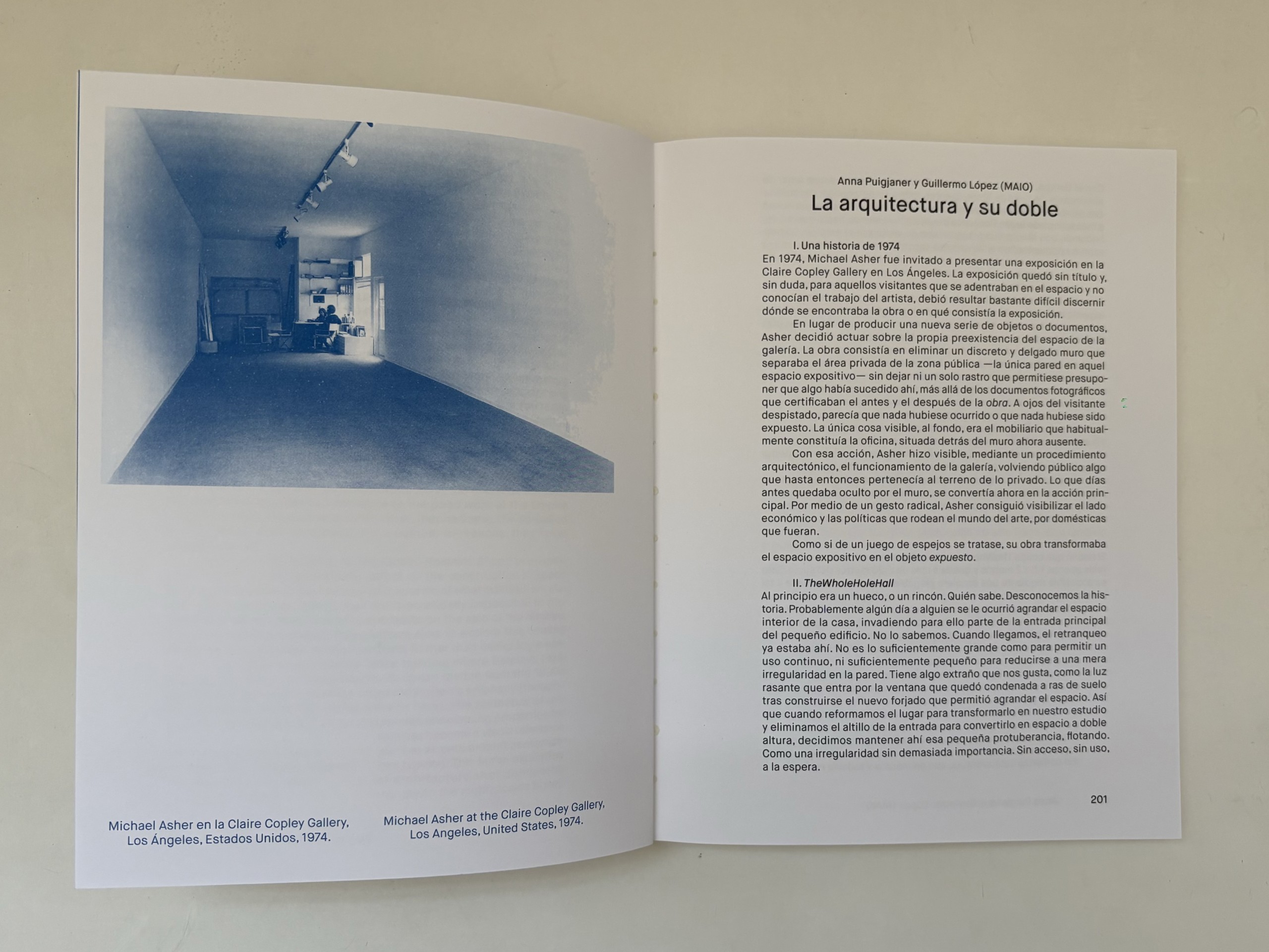
In 1974, Michael Asher was invited to present an exhibition at the Claire Copley Gallery in Los Angeles. The exhibition had no title, and doubtless those visitors who ventured into the space without prior knowledge of the artist’s work found it difficult to decide where it was, or what the exhibition comprised at all.
Rather than producing a new series of objects or documents, Asher decided to address the gallery’s own preexisting space. The work comprised eliminating a discreet and thin wall that separated private and public zones of the gallery-the only wall in this particular exhibition space-without leaving any trace of what had occurred. To the eyes of the unsuspecting visitor, nothing seemed to have happened or nothing was on show. The only visible objects, to the rear of the space, were the items of office furniture that were previously concealed behind the absent wall.
With this action, Asher made visible, via an architectural procedure, the operation of the gallery, making public something that until then had been considered private. What was previously hidden behind the wall became the main activity. By means of this radical gesture, Asher revealed the financial aspects of the art world and the policies that define it, on however small a scale.
As if it were a hall of mirrors, his work transformed the exhibition space into the exhibited object.
II. TheWholeHoleHall
In the beginning it was a gap, or a corner. Who knows. We don’t know the story. Most probably someone someday decided to expand the living space of the house, and in doing so invaded part of the main entrance of the small building. We can’t be sure. When we arrived, the recess was already there. It is not large enough to provide for continual use, but nor is it small enough to simply be an irregularity in the wall. There is something strangely attractive about it, like the raking light that comes in through the window which was obliged to remain at floor level by the construction of the new slab that enabled the expansion of the space.
So when we reorganized the space to transform it into our studio and eliminated the mezzanine over the entrance to create a double-height space, we decided to leave the small alcove there, floating above the floor level, an irregularity, of no particular importance. Inaccessible, purposeless, waiting.
Over time, the niche was unintentionally transformed into a storage space. It filled up with books. Hundreds, thousands of books, piled up in a chaotic fashion. Then a set of new shelves allowed us to provide them with a more appropriate arrangement. Nothing much else happened. Until one day, chatting with Moritz Küng, who was visiting the studio, we began to remark on how much the space reminded us of the one he used as the starting point for his series of exhibitions “The Umbrella Corner: an Exhibition in 6 Chapters.”
Faithful to his argument, in the series “The Umbrella Corner,” Moritz converted a small niche in the Barcelona gallery ProjectesSD into the exhibition space. In this way, a space that is generally invisible or ignored used only for people to leave their umbrellas on rainy days, acquired a central role. A leftover, a wasted space, became the main site and argu-ment, to which the work was curiously anchored. The traditional dichotomy between form and content, foreground and background, thus began to dissolve, generating a new narrative. A unique and somehow unrepeatable story.
To paraphrase Bachelard, we could say that Moritz Küng is a “reader of corners.” Someone interested in seeking the specific, everything that enhances the specific character of an exhibition space. Moritz tracks down the genii loci that are the exact opposite of everything represented by the “white cube,” the exhibition space that is (falsely) indifferent and neutral with regard to whatever is exhibited there.
These are the ideas that are behind the diminutive space we manage together with Moritz and the designer Curro Claret. A place we christened with the somewhat unpronounceable and Joycean name TheWholeHoleHall – Room for Spatial Concerns, and one that is concerned with reflections on space.
III. UP
The corner occupied by TheWholeHoleHall, which we referred to above, measures just 1.6 x 2 meters and is more than 2.2 meters above floor level.
It is only accessible by means of a folding wooden ladder built for that very purpose. In fact, reaching it is part of the performance that accompanies each exhibition, which we prefer to call Acts. Each Act is accompanied by the ritual of getting down and unfolding the ladder, and watching as guests and viewers climb up to the diminutive exhibition area. There is something of an initiation rite about it.
The first Act (a name that somehow recalls the idea of the performance, linked to the unrepeatable character of something that is temporary and ephemeral) comprised the presentation of the fanzine UP, a publication that presents works of architecture selected by its editors, artist Koenraad Dedobbeleer and architect Kris Kimpe, in the form of a photo-essay. Not without a certain irony and sense of randomness, the presentation of UP took place up there, the audience gazing up at two guys with their legs dangling two meters above them.
So began this new and ongoing adventure.
IV. Doppelgänger
Paradoxes of Exhibited Architecture
TheWholeHoleHall, with its distinctive format, has inevitably forced us to think about what it means to exhibit architecture, and about the relationship between what is exhibited and the exhibition space itself.
Putting architecture on show demands reflection, precisely, on the relationships between reality and representation, on the operation-never free of paradox-that tends to generate complex frameworks in which the object and its image end up taking on a life of their own.
Indeed, one of the conceptual obstacles that the architecture curator regularly has to face is the impossibility of displaying or moving the object itself, without depriving it of many of the attributes that serve to legitimize it: its context, its function, its meaning. The impossibility of reconciling the object and its representation. It is precisely here that, paradoxically, the representation itself becomes a parallel form of architecture, a new nature: every time we try to exhibit a preexisting architecture, we inevitably generate a new one.
At this moment, when what is represented frees itself from its subordinate condition and takes on a life of its own, reality and image enter a dialogue as if they were two complementary figures: architecture and its double- its Doppelgänger-share a single stage, forming a unity in which real and imaginary are merged, where thought can take on the value of the physical and vice versa.
Exactly as occurs in Michael Asher’s work Untitled, with which we began this text. Only then are the values of representation and of construction mixed up, giving meaning to architecture understood as a form of production that is not only physical, but also cultural, narrative, and critical.
