
LIGA Book vol. 1 “Even small spaces start small”
La Boîte à Miracle – Exhibiting Architecture
Moritz Küng
Architecture is a discipline that, beyond a complex set of topographical, climatological, economic, legal, functional, and cultural inputs, also integrates a wide range of outputs: theory, sketches, plans, models, renderings, 3D animations, full-scale construction samples, and, once completed, photography, film, and criticism.
Inputs can be understood as a critical mass whose analysis, articulation, and development ultimately give rise to built reality. Outputs, by contrast, act as surrogates of architecture’s essence. This is particularly evident in media representations: journals, catalogs, monographs, websites, and exhibitions.
This raises the question: what does it mean to exhibit architecture? Unlike autonomous arts, whose goal is to reach an audience by leaving the studio and entering the museum, heteronomous architecture—subject to external forces—already constitutes public space. It is inevitably embedded within a collective framework and anchored to a specific place.
Architecture can be said to exist in two realities: an existential one and a media-based one. The former requires physical presence to be experienced—encountered “at eye level,” walked through and around. Architecture engages not only the intellect—through genius or function—but also the senses: materials, volume, and the specific or ephemeral qualities of a place. Its perception demands time and active engagement.
In media reality, however, architecture is “transported,” “multiplied,” and “democratized.” In the process, these essential qualities are diminished. Architecture becomes easy to consume, but also distorted.
Media representations are not immediate; they are filtered, interpreted, and manipulated. Certain aspects are emphasized or erased, idealized or trivialized. Consider renders that depict unbuilt projects as hyper-real, or photographs in which context is removed, rearranged, or dramatized.
At this point, architecture abandons its spatial condition and becomes image, finding validation in analog and digital media. Against this, exhibitions retain a crucial value: spatial experience.
Yet architecture exhibitions—whose number has grown exponentially—too often rely solely on such surrogates and ignore the conditions of the exhibition space itself. This may be due to their ephemeral nature or to architects’ preference for publications, which offer broader and longer-lasting visibility.
Taking exhibitions seriously means moving beyond representational devices. This logic can be expressed as:
Architecture exhibition =
exhibited architecture × exhibition architecture
Thus, exhibitions should be understood as autonomous spatial productions—temporary yet real environments requiring physical design.
It is also important to distinguish architecture from sculpture or installation, as well as from models and mock-ups. Sculpture and installation are autonomous forms, free from functional constraints. Models and mock-ups offer spatial understanding, but only as miniature or fragment.
This suggests that architecture exhibitions are highly constrained. Does this make them impossible?
On the contrary, exhibitions can produce value when they generate abstract models of thought or engage the genius loci—context as critical mass. This is precisely what defines LIGA – Space for Architecture – Mexico City.
Over two years, this venue has presented ten young architects from six Latin American countries, each creating an “architecture” within a 16 m² space. Far from a neutral white cube, the triangular gallery—with its glass façade and constraints—has enabled diverse, site-specific installations.
Themes range from ephemeral phenomena—light, reflections, balance, climate, sound—to abstract concepts such as modernity, urban structures, the park, or the museum.
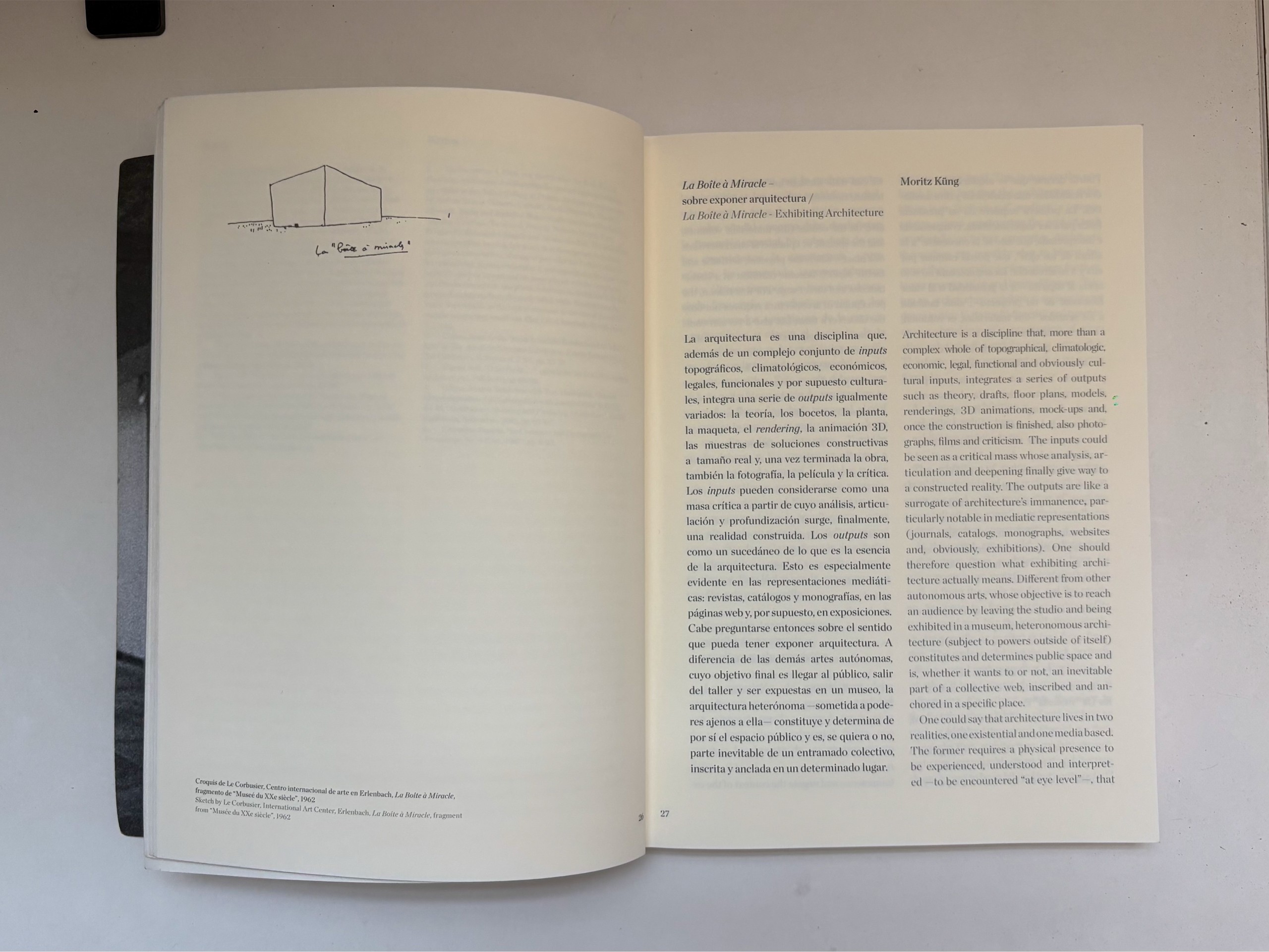
Often, the exhibition space itself becomes abstract. This recalls a sketch by Le Corbusier for an unbuilt arts center (Erlenbach, 1963): a seemingly monumental volume that can also be read as a small box. He titled it La Boîte à Miracle—the magic box. That idea finds resonance in this small exhibition space at 348 Avenida Insurgentes Sur.
