
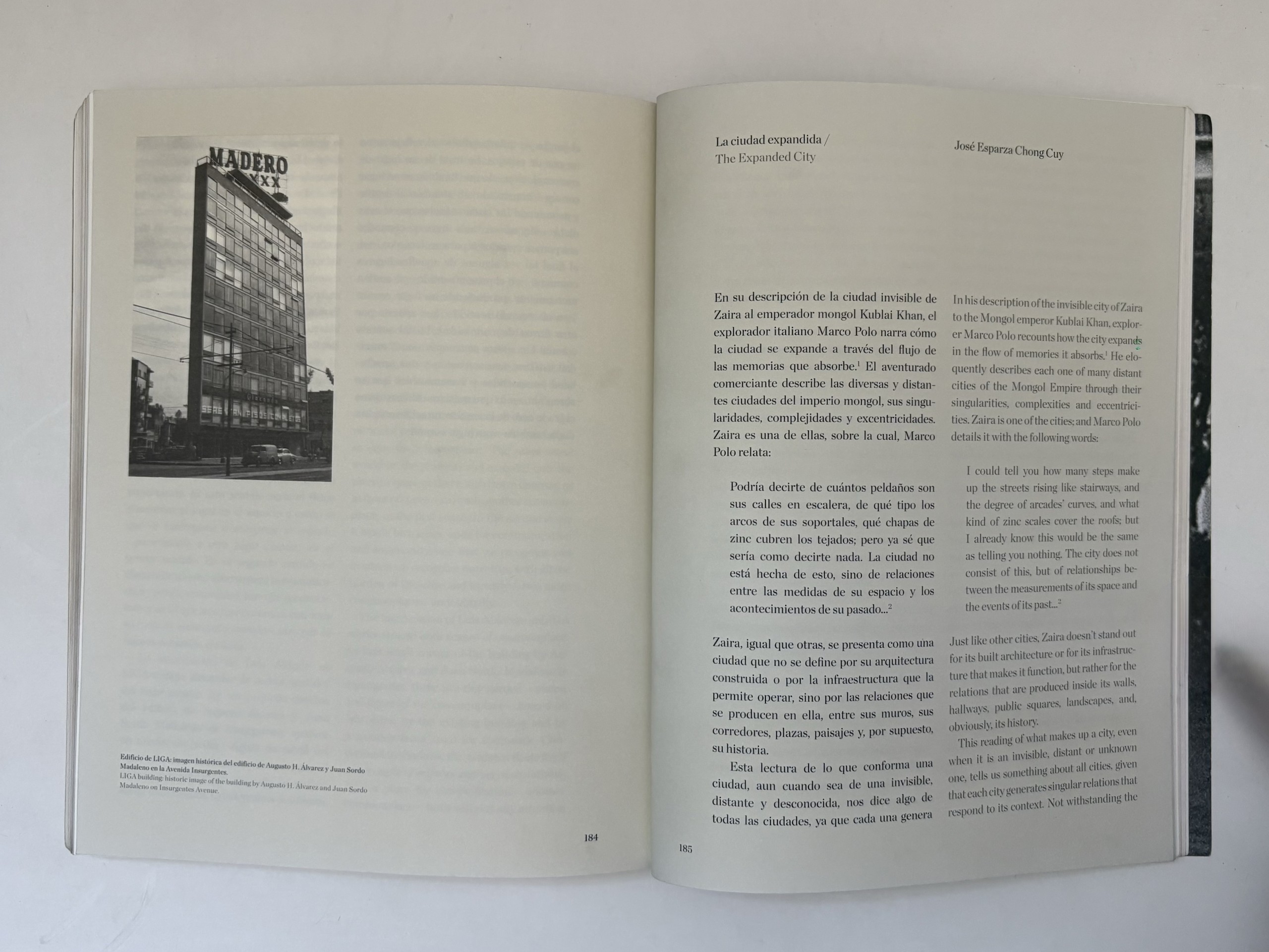
LIGA Book vol. 1 “Even small spaces start small”
The Expanded City
José Esparza Chong Cuy
In his description of the invisible city of Zaira to the Mongol emperor Kublai Khan, explorer Marco Polo recounts how the city expands in the flow of memories it absorbs.1 He eloquently describes each one of many distant cities of the Mongol Empire through their singularities, complexities and eccentrici-ties. ‘Zaira is one of the cities; and Marco Polo details it with the following words:
I could tell you how many steps make up the streets rising like stairways, and the degree of arcades’ curves, and what kind of zine scales cover the roofs; but I already know this would be the same as telling you nothing. The city does not consist of this, but of relationships between the measurements of its space and the events of its past…2
Just like other cities, Zaira doesn’t stand out for its built architecture or for its infrastrue-ture that makes it function, but rather for the relations that are produced inside its walls, hallways, public squares, landscapes, and, obviously, its history.
This reading of what makes up a city, even when it is an invisible, distant or unknown one, tells us something about all cities, given that each city generates singular relations that respond to its context. Not withstanding the distant analogy, the stories of Marco Polo can be understood as efforts whose goal it is to link and approximate foreign bodies of knowledge to a specific audience with the intention to amplify the limits of their un-derstanding. It is an exercise that aims to expand an immediate context-the one we inhabit.
By comparing this story with contemporary architectural practice (understood as a global and interconnected discipline), its representation and discourse should connect with the multiple references where it is produced.3 Under this premise, architecture can be equally read as the reflection of all experiences that happen inside; as an agglomeration of all the stories of the invisible cities visited by Marco Polo.
Understanding this concept of an expanded architecture (conceptually and geographically speaking), LIGA-Space for Architecture-Mexico City, shows affinities with Marco Polo’s narration; it brings us memories, records and ideas of near and far cities, showing them as similar to our experiences and absorbing them into a small ground floor showroom on the dynamic Avenida Insurgentes in Mexico City.
Featuring residential buildings, stores, and services of different scales, this avenue provides an experience that allows us to see through a window almost 30 kilometers long, showing us the eclectic nature of Mexico City. Here, starting from the spine of the city that connects the capital with a network of activities that happen in the rest of the metrop-olis, LIGA’s efforts to amplify the discourse and understanding of architecture are presented to an audience that is as varied as the city itselt. It is a sister city of Marco Polo’s invisible cities.
The exhibition space absorbs these ideas not only through the transparent windows that make the surrounding architecture vis-ible, but also through the persons who talk about it and dislocate the gallery where they are presented. This is how they bring them with them, as experiences beyond the confines of the gallery. The gestures of LIGA, through careful selection of invited architects and their efforts to bring together a wide audi-ence, are proof of a true commitment to linking the context of production in Mexico with a global practice, and vice versa. LIGA not only brings Medellin, Rio de Janeiro and Buenos Aires (to name a few) to Avenida Insurgentes, but also brings the avenue itself —and hence Mexico City-, to these cities.
LIGA emerges at a time when the change of direction in architectural practice is visible and responds to the necessity to present a discipline with multiple references and forms of production, thus diversifying the architectural panorama. The act of exhibit-ing, showing and seeing only ends when the viewers appropriate the generated discourse and finish it in their daily activities, in their immediate context and beyond. The efforts of LIGA are not only reduced to the act of showing, given that through their activities they operate as an engine of debate and critical reflection. It is an incubator of thought, production and exchange.
Taking this into account, the significance of LIGA lies in the act of linking, in the aim to produce new kinds of knowledge that start from the understanding of other contexts, in generating comparative discussions to be able to understand our reality from a critical and comprehensive perspective. It is here that many who are interested in the discipline’s limits relate socially and come into contact with a community of people that identifies with this discourse. It is important to understand LIGA as a center that not only links distant geographies, but that also responds to a contextual necessity by offering a meeting and exchange space. LIGA is a place that agglomerates, links, and generates community.
The accumulated memory of these new relations connects us with distant geographies and realities. LIGA presents voices that seem similar but that respond to particular contexts. Seen from a conceptual perspec-tive, in its totality, the representations of all these spaces conform to a new city that is composed of weight of the experiences of these places. These experiences agglomerate in the space on Avenida Insurgentes and together make up the expanded city not unlike how Marco Polo concludes his tale of Zaira for the Emperor:
The city, however, does not narrate its past, but contains it like the lines of a hand, written in the corners of the streets, the gratings of the windows, the banisters of the steps, the antennae of the lightning rods, the poles of the flags, every segment marked in turn with scratches, indenta-tions, scrolls.4
These scratches, indentations, and other marks of distant cities are what LIGA presents to connect us with a more universal and inclusive architecture.
Notes
