
LIGA Book vol. 1 “Even small spaces start small”
No Space for Architecture
Wonne Ickx & Ruth Estévez
In Latin America, there is no space for architecture. That doesn’t mean that there is no room to erect new buildings or to develop new opportunities—these are abundant, especially when compared to the current scarcity of alternatives in Europe and the United States. The lack, nevertheless, has to do with infrastructures that permit a context of discussion and reflection around the activity of designing and constructing: a body of instances, platforms, publications, and critical filters that define local practice from their own centers of production, generating the feedback that architects need for their intellectual progress. A studio’s success is measured by its entrepreneurial capacity, prioritizing the quantity of built work over its quality, or taking pleasure in the repetition of the same project in commercial journals, as well as its popularity on Facebook.
The publication of commissioned monographs—generally paid for by the architecture offices themselves—leaves little room for objective criticism and confuses the spectrum between those who are doing genuine work and those who are simply “doing well.”
It is also problematic that the discourse on Latin American architecture continues to be created from abroad. The separation between theory and practice often leads to misunderstandings, exclusions, and, fundamentally, a constant tendency toward generalization, as if all production were sheltered under a single umbrella. The few times that architecture from a Latin American country appears in global debate, it does so through a “developmentalist” lens, emphasizing socially oriented production aimed at marginalized communities, infrastructural issues, or the right to housing. A perfect example is the recent winning project at the Venice Biennale, where a dramatized reenactment of the Torre David in Caracas, Venezuela, received the Golden Lion.
When Latin American architects are invited into international circuits, the subject of debate often falls on their marginal condition. As a result, architectural discourse tends to revolve around familiar topics: the megacity, the border, the favela, socio-spatial segregation, or informal self-construction—all of which guarantee inclusion from a Western-centric perspective.
Architects whose work does not directly engage with these regional issues have few opportunities to find a platform for cultural discussion about their practice.
If criticism is produced elsewhere and is shaped by a paternalistic tone of inclusion, it became necessary to found a space that would invert this logic. A space where discussions emerge with the conviction that there is not a single genealogy, but multiple practices with different interests, yet with certain shared characteristics that cannot be ignored. A space where invited Latin American practices can reflect on their work without the daily pressure of clients and the real estate market.
LIGA—Space for Architecture—Mexico City emerged as a non-profit without institutional aspirations, distancing itself from unifying visions to focus on small details. It is an intellectual platform that simply grants visibility to those who lack it—which, in itself, is a statement.
Although the history of architecture exhibitions is yet to be fully written—a hot topic in recent years—it has proven to be fertile ground for research and methodological innovation, significantly expanding the conceptual limits of the discipline. Not for nothing did both Mies van der Rohe and Le Corbusier make their first important contributions to modern architecture through their canonical exhibition pavilions, years before the Villa Savoye or the Farnsworth House established them as key figures of modern architecture.
This is also true of architects and practices such as The Smithsons, Venturi, Rossi, or Koolhaas, for whom exhibition production has been central to their work. The radical groups of postwar Italy, Superstudio and Archizoom, were explicitly founded to participate in the exhibition Superarchitettura in 1966—an event that even helped define their identity.
Exhibitions, however, still remain a footnote in the history of architecture. Yet it is precisely in this context that discourse has been defined at the level of practice, theory, and criticism. While the mute stone of built work may obscure architectural thought with its imposing presence, exhibitions serve as privileged vehicles to clarify an author’s position.
Exhibiting architecture is inherently complex due to the problem of representation. Architecture exists in the real world, and when brought into the exhibition space, it becomes the reflection of an absence. The French historian Jean-Louis Cohen explains this through the distinction between ouvrage and oeuvre: “since the ‘ouvrage’—that which refers to the constructed work—cannot be physically present in the exhibition space, what is actually represented is the ‘oeuvre’, that intellectual complex of interests, inspirations, problematics, and techniques surrounding the act of construction.”
If, in art exhibitions, the object of desire is physically present, architecture exhibitions are constructed from the absence of that object and the internal desire to reach it. “So we, wretched castrati, never able to show the thing itself, are condemned forever to representations (models, drawings, photographs) and simulacra,” writes Jeff Kipnis.
Two main strategies have been used to address this issue. The first embraces representation, emphasizing the artistic quality of drawings, plans, photographs, and models as autonomous objects. The second avoids representation through mimesis, constructing full-scale installations or emphasizing exhibition design as architecture in itself.
The first risks detaching architecture from its lived context; the second misses the opportunity to temporarily free the discipline from its programmatic constraints. Yet herein lies the strength of exhibitions: precisely because of absence, they enable synthesis and abstraction.
The exhibition practice developed at LIGA requires architects to deconstruct their projects into fragments—not necessarily scaled representations, but ideas, interests, and conceptual frameworks that reveal the genesis of their work. In doing so, the act of designing an exhibition becomes a creative process that explores new translations of architectural thinking.
LIGA’s curatorial line was not defined from the outset. Instead, it was the space itself—irregular, triangular, and extremely compact—that shaped its direction. Its constraints make conventional exhibitions difficult and instead encourage experimentation.
Joseph Grima described a similar condition at Storefront for Art and Architecture, where the curatorial program emerged in direct dialogue with the building’s strong architectural identity, making traditional approaches ineffective.
At LIGA, curatorial work develops in close relation to the space, turning each exhibition into a site-specific installation. This creates a subtle boundary between art installation and architectural exhibition.
These exhibitions are anchored in the present and in their immediate context: the city, its chaos, and everyday life. Rather than representing specific projects, they generate autonomous spatial configurations linked to the invited architect’s thinking.
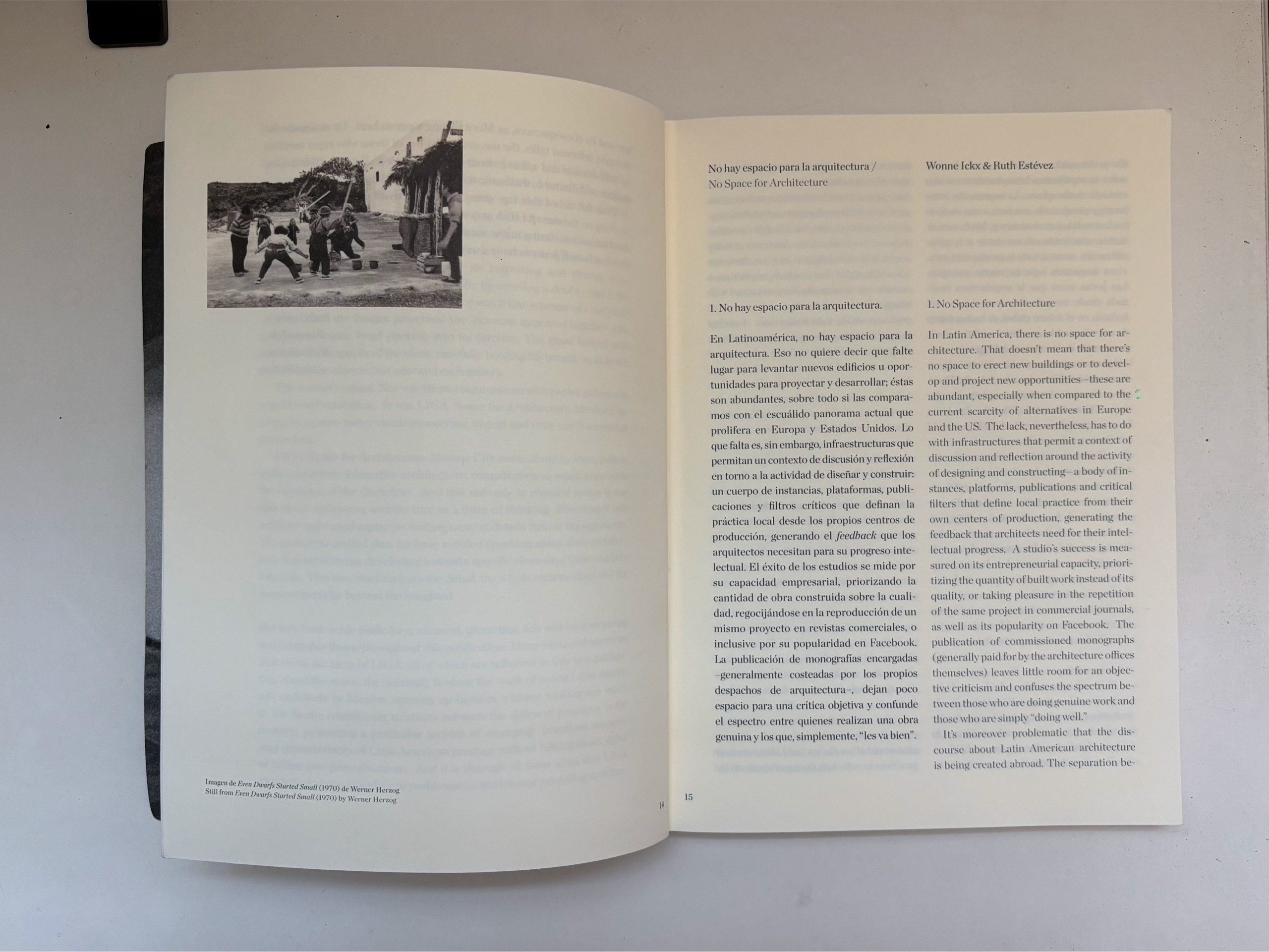
A useful metaphor can be found in Werner Herzog’s 1970 film Auch Zwerge haben klein angefangen (Even Dwarfs Started Small). The camera, positioned at the eye level of little people, transforms the perception of reality—not by representing it, but by reconstructing it.
Similarly, LIGA’s exhibitions do not represent architecture; they produce a new reality from it. Scale here is not about reduction or enlargement, but about the confrontation between different realities. The encounter between exhibition space and content becomes central.
Projecting—rather than representing—becomes the method of communication, generating a new and autonomous context of production.
Notes
Archizoom was founded by Andrea Branzi, Gilberto Corretti, Paolo Deganello, Massimo Morozzi, Dario and Lucia Bartolini.
Superstudio was founded by Adolfo Natalini, Cristiano Toraldo di Francia, Roberto Magris, Piero Frassinelli, Alessandro Magris, and Alessandro Poli.
Although exact dates are not specified, it can be assumed that both groups formalized their work before, during, or shortly after the exhibition. A second exhibition, Superarchitettura 2, was held at the same gallery in 1967.
