
Foto: Arturo Arrieta
LIGA 42: Plinth for No Thing
Gru.a (Brazil)
There are more things in Zócalo and Copacabana, Horatio, than are dreamt of in your philosophy. I paraphrase Shakespeare to contemplate the relations between these two immense public spaces in Mexico City and Rio de Janeiro. The Brazilian office gru.a recognized the similarities of the two celebrated Latin American public spaces as places of convergence for people, coexistence for differences, enjoyment and conflict, the exacerbation of civic necessities, the manifestations of collective identity, and the latency and emergence of the spirit of the age.
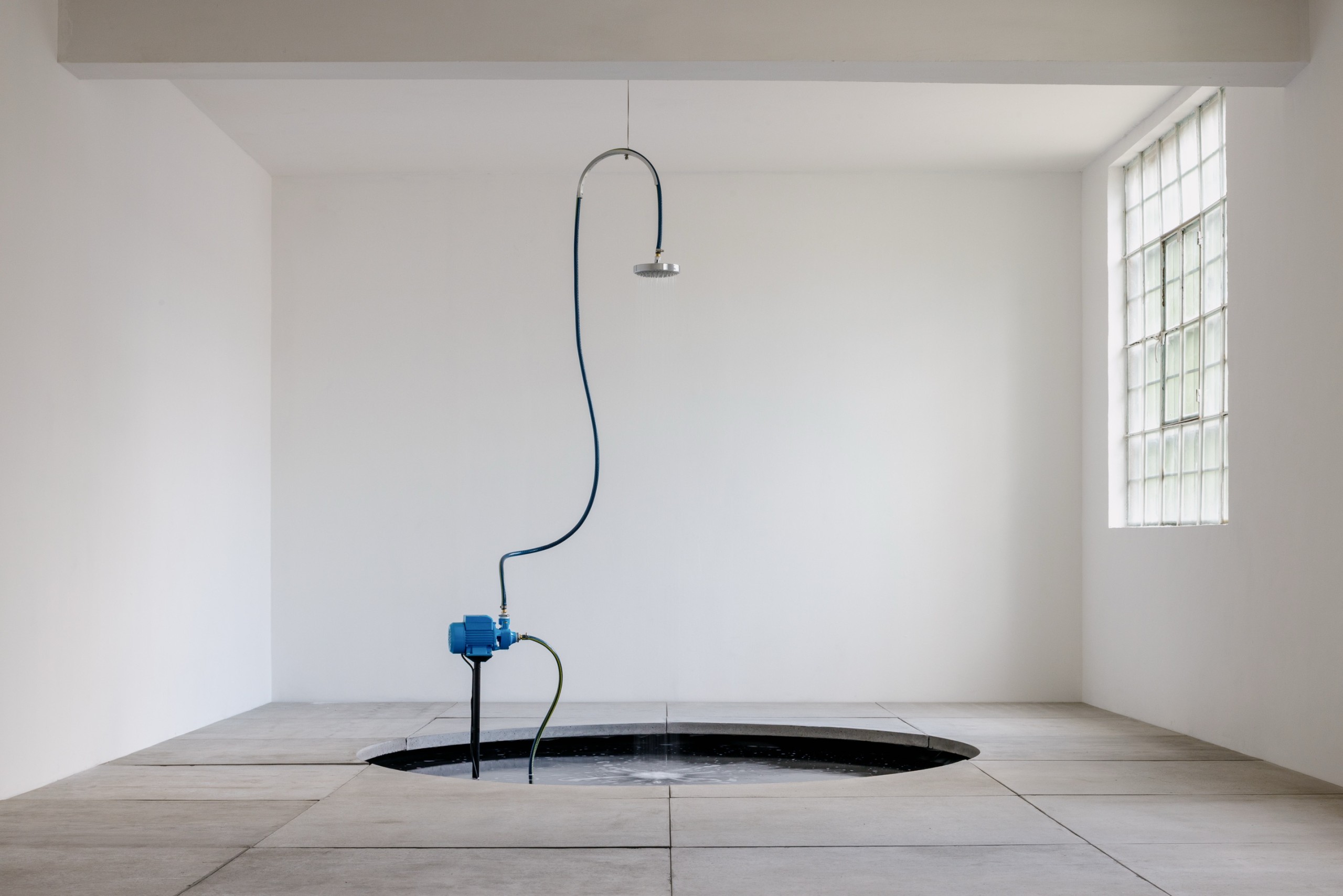
Notorious and notable, the Plaza de la Constitución and Copacabana Beach are grandiose in scale, yet it is in this small, 30m² environment that their essences were understood, contained, and intertwined. This is possible because here they engineered an unpretentious device for human congregation: a public shower – the chuveirão.
Gru.a noted the gregarious powers of such a mundane hygiene fixture when reading a newspaper article from 1970, in which beachgoers claimed that the showers on Copacabana beach were used by both the former democratic president Juscelino Kubitschek and the generals of the dictatorship then in power in Brazil. Extracted by pressurized pumps, the waters continue to gush from the Copacabana showers, stirring up the sands and changing their consistency, which gradually transforms the unstable topography of the beach’s kilometer-long surface.
From these changes in the soil emerges an analogy with the main square in the historic center of this Mexico City. Its nickname derives from a hidden but unsuppressed structure: Zócalo refers to the circular pedestal, 8 meters in diameter, for a monument conceived in the 19th century but never built. Since then, that plinth has been buried beneath the Plaza de la Constitución. The name by which the population became accustomed to referring to that public space concerns something that is not seen. Until, for a period in 2017, archaeologists excavated the earth and unearthed the zócalo itself.
This negative circular form was appropriated in this architecture-archaeology by gru.a: they designed a surface to be continuously stirred up by the waters of this chuveirão. This shower is the quintessence of the Brazilian gambiarra or, using Claude Lévi-Strauss’s definition, the device of a bricoleur: one who “executes a work using means and expedients that denote the absence of a preconceived plan” and “always makes do with […] residues of previous constructions and destructions.”
